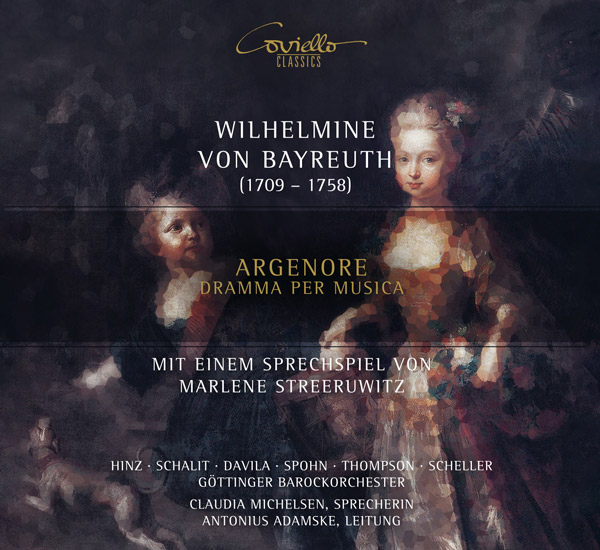
On 10 May 1740, Wilhelmine of Bayreuth’s (1709–1758) birthday opera Argenore was to have its premiere at the Margravial Opera House in Bayreuth—yet the celebration never took place. This dark dramma per musica, in which only a single exiled character survives while King Argenore reigns with unprecedented cruelty, unmistakably reflects the composer’s own life. The unwanted princess at the Prussian court, subjected to the arbitrary rule of her father, Frederick William I, and marked by her troubled relationship with her brother Frederick II, found expression in the tyrannical King Argenore and the lost son Eumenes/Ormondo. Musically, the opera is distinguished by its highly expressive use of key relationships for the sympathetic characters and by the exceptional prominence of Ormondo, whose role includes six arias.
In 2022, amid a world shaken by pandemic and war, the Göttingen Baroque Orchestra presented Argenore for the first time, revealing how the king’s authoritarian rule—fuelled by fake news—leads inexorably to catastrophe. While the production attracted considerable acclaim, it also inspired the desire for a more concise adaptation. Tailored to contemporary listening habits, the original Italian recitatives have been replaced by a fictional German-language monologue by Marlene Streeruwitz, while all of Wilhelmine’s arias remain intact in their original form, allowing the dramatic power of her music to unfold with undiminished intensity.