
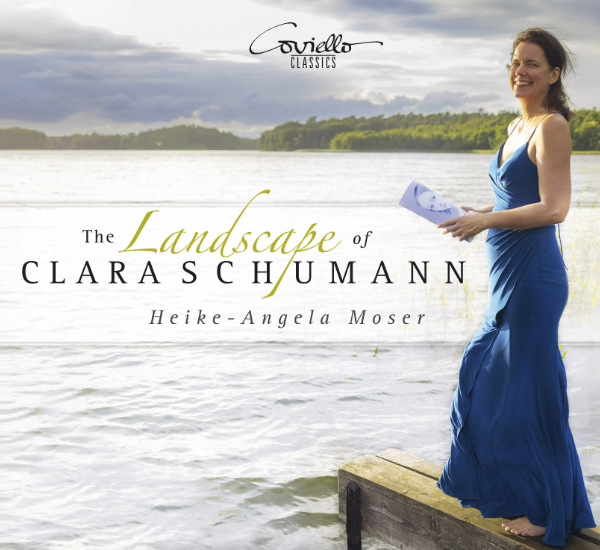
Heike-Angela Moser ⋅ Fortepiano
Works for solo piano by Baldassare Galuppi, Franz Schubert, Johannes Brahms, Fanny Hensel, Clara Schumann, Robert Schumann, and Pauline Viardot-Garcia
Edition: Authentic Performance
Booklet: de / en
Media: CD / Download
COV 92608
Like a finely drawn musical panorama, “The Landscape of Clara Schumann” unfolds as a recording that brings together historical resonance, personal perspective, and contemporary sound into a richly layered whole. Pianist Heike-Angela Moser, a descendant of Clara Schumann, approaches the legacy of her ancestor in a very special way — not as a nostalgic look back, but as a living artistic dialogue between heritage and future.
The selection of works spans a wide arc from the Baroque through the Classical period to the High Romantic era, revealing an intricate network of musical voices that surrounded, inspired, and shaped Clara Schumann: from Baldassare Galuppi to Franz Schubert and Johannes Brahms, as well as composers such as Fanny Hensel and Pauline Viardot-Garcia. Rather than offering a musicological reconstruction, Heike-Angela Moser explores these sound worlds as an inner landscape, unfolding in dialogue with Clara Schumann’s artistic energy.
A central element of this recording is the Schiedmayer fortepiano from 1859, whose historical character and subtle timbral palette allow the repertoire to emerge with a rarely heard authenticity. The instrument tells its own story: it challenges, guides, limits, and liberates at the same time — creating a space in which the intimacy and expressive depth of the nineteenth century can be experienced anew.
This project was made possible through the support of the Schiedmayer Foundation, whose commitment to historical sound culture played a key role in bringing the recording to life.
The label Coviello Classics, renowned for its sonic precision and artistic standards, provides the ideal framework for this release. The recording continues the label’s tradition of bringing together musical rarities, individual interpretations, and distinctive sound aesthetics.
“The Landscape of Clara Schumann” can be understood as a poetic journey in sound: a dialogue between generations, between memory and renewal, between the historical breath of an instrument and the living voice of its present-day interpreter.
|
Baldassare Galuppi (1706-1785) |
||
| 1. |
I. Andante |
5:35 |
| 2. |
II. Allegro |
4:09 |
|
Franz Schubert (1797-1828) |
||
| 3. |
I. Allegro assai |
9:49 |
| 4. |
II. Allegretto |
13:11 |
| 5. |
III. Allegro |
5:35 |
|
Johannes Brahms (1833-1897) |
||
| 6. |
I. Andante moderato |
5:05 |
| 7. |
II. Andante non troppo e con molta espressione |
5:36 |
|
Fanny Hensel (1805-1847) |
||
| 8. |
Allegro Molto in C Minor |
3:57 |
|
Felix Mendelssohn (1809-1847) |
||
| 9. |
Allegretto grazioso „Frühlingslied“ |
2:30 |
|
Clara Schumann (1819-1896) |
||
| 10. |
Scherzo in D Minor, op.10 |
5:59 |
|
Robert Schumann (1810-1856) |
||
| 11. |
Romance in F sharp Major, op.28 Nr. 2 |
3:41 |
|
Pauline Viardot-Garcia (1821-1910) |
||
| 12. |
Serenade in F Minor |
4:12 |
| Total time: |
1:09:26 |
|